
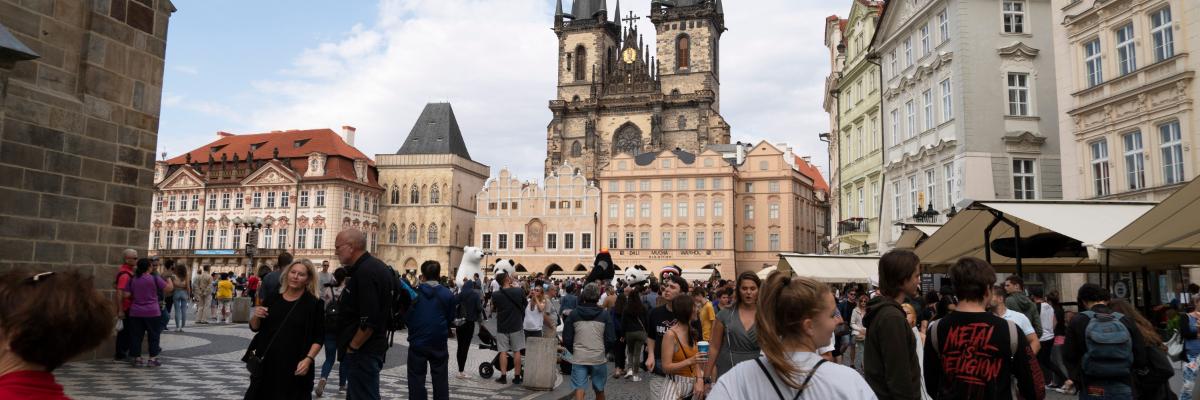
Czechia has more than 50 higher education institutions, according to the official Study in Czechia portal. They fall into three groups:
The Study in Czechia search engine lists more than 5,000 programmes, over 1,000 of them in English. You can filter by language, city, level and tuition fee.
Czech higher education has three cycles:
The academic year is split into a winter and a summer semester. Most programmes start in September.
Czechia – bachelor's programmes
Czechia – integrated (single-cycle) programmes
Czechia – master's programmes
Czechia – doctoral programmes
You apply directly to the faculty of your choice, usually through its online application form. For programmes starting in September, applications usually close between February and April. The application fee is usually a few hundred Czech crowns – up to around CZK 1,000.
The faculty may ask for:
Your secondary school leaving certificate may have to be recognised in Czechia (nostrifikace) before you enrol. Certificates from some countries – Poland, for example – are valid directly thanks to equivalence agreements. Even then, the Ministry of Education (MŠMT) recommends attaching an officially certified copy of your certificate with an official translation into Czech. Check the rules for your country on the MŠMT website (see: Useful links).
If you come from outside the EU, apply early: you need the admission letter for your visa application, and the visa procedure can take up to 60 days (see: Residence and formalities).
Each faculty decides how it selects students. Some programmes require an entrance exam, an interview, a portfolio review or an aptitude test (arts programmes).
Many faculties in Czechia and Slovakia replace or supplement their own exams with the National Comparative Exams (Národní srovnávací zkoušky, NSZ), run by the company Scio. They take place seven times a year, also online. The faculty's admission rules tell you whether it accepts them.
At public universities, programmes are taught mainly in Czech. Many require at least level B2. If you speak another Slavic language, Czech will come more easily – but it is still a foreign language, so plan on taking a course. Universities offer fee-paying preparatory courses that combine intensive Czech with preparation for the entrance exams in your subjects.
There are more than 1,000 programmes taught in English. For these you will usually need IELTS or TOEFL – the university sets the required score. Remember that programmes taught in English usually charge tuition (see: Tuition fees).
EU/EEA and Swiss citizens do not need a visa – you enter with a valid ID card or passport. If you stay longer than 30 days, you must report your place of residence to the Foreign Police (Cizinecká policie) within 30 days of arrival. If you live in a student residence or a hotel, the accommodation provider can do this for you.
Students from outside the EU/EEA who stay longer than 90 days need a long-term visa for the purpose of studies, valid for up to one year. You apply in person at a Czech embassy or consulate – book an appointment first. The procedure can take up to 60 days. For a stay longer than a year you need a long-term residence permit for the purpose of studies. You will need, among other things, confirmation of your studies, proof of accommodation, a criminal record certificate and proof of funds. The amount is based on the subsistence minimum of CZK 3,130 a month: for a full academic year (1 September to 31 August), the Ministry of the Interior's Foreigners' Portal gives CZK 115,810 (2026). The consular fee is CZK 2,500.
Health insurance: if you are insured in another EU country, bring your European Health Insurance Card (EHIC). Students from outside the EU need travel medical insurance for the first 90 days and comprehensive health insurance after that – or comprehensive insurance for the whole stay – before the visa is issued.
Programmes taught in Czech at public and state universities are free – whatever your nationality. You only pay the application fee and your living costs.
You will have to pay if you:
The rules are the same for EU and non-EU students. You will find the fee for a specific programme in the university's catalogue or in the Study in Czechia search engine (“tuition fees” filter).
According to Study in Czechia, you will usually need €500–800 a month to live. Some typical prices:
Prague is the most expensive city. You usually apply for a room in a student residence through your university – do it as soon as you are admitted. More details on studyin.gov.cz.
Since programmes taught in Czech are free, scholarships mostly help with living costs or with spending part of your studies in Czechia:
Czech Government scholarships are only for students from selected countries outside the EU. You will find the full list of programmes on studyin.gov.cz/scholarships.
EU/EEA citizens have the same access to the labour market as Czech citizens – no permit is needed. Students most often work under two types of agreement:
Students from outside the EU/EEA who study an accredited programme full-time at a Czech university have free access to the labour market, so you don't need a work permit. The official rules do not set a weekly hour limit.
The minimum wage is CZK 134.40 an hour or CZK 22,400 a month for full-time work. In a typical student job you will earn around CZK 150–200 an hour.


Sources: European Commission – Study in Europe (education.ec.europa.eu/study-in-europe), Eurostat, official national study and residence portals and authorities, Eurodesk, enic-naric.net, studentnews.eu. As of September 2026.
 EN
EN 
 CS
CS DE
DE ES
ES FR
FR HU
HU IT
IT PL
PL PT
PT РУ
РУ SK
SK TR
TR УК
УК AR
AR 中文
中文